

20 April 2026
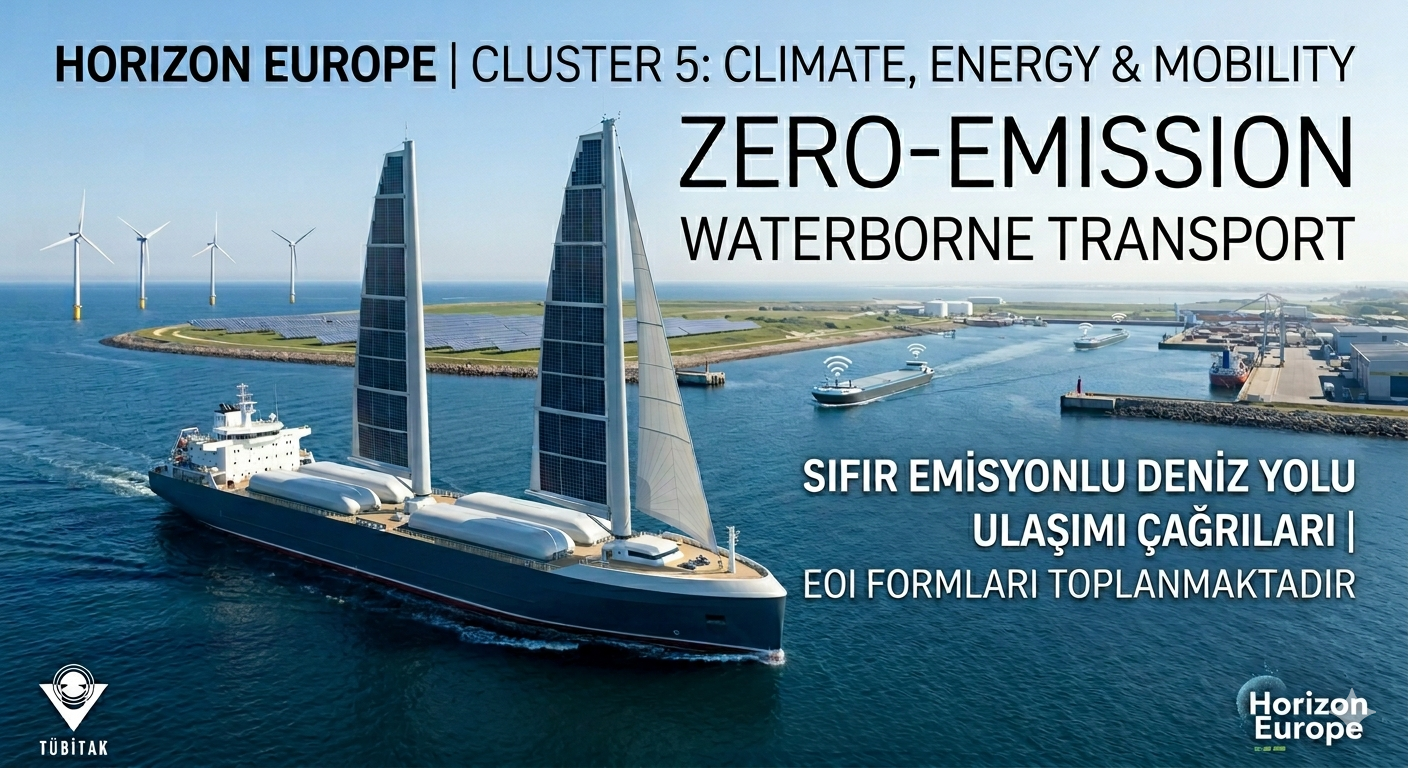
CLUSTER 5: Climate, Energy, and Mobility Under the Mobility area, Destination 5: Zero-Emission Waterborne Transport, Expressions of Interest (EOI) are being collected for the calls listed below. These calls will open on December 15, 2026, and remain open for applications until April 14, 2027.
If you require the support of National Contact Points (NCPs) during the partner search process, you may send your EOI form—prepared in English and aligned with the "expected outcome" and "scope" of the specific call topic—to ncptransport@tubitak.gov.tr by the end of the day on April 24, 2026. Please click here to download the form template.
- HORIZON-CL5-2027-03-D5-14: Onboard renewable energy solutions and energy saving measures to reduce the fuel consumption of ships by at least 55% (ZEWT Partnership) This call aims to develop innovative solutions to reduce ship fuel consumption by at least 55%. Project requirements primarily cover the efficient use of onboard integrated renewable energy sources (such as solar and wind), advanced energy recovery systems, and energy-saving measures that enhance operational efficiency. The work is expected to integrate these technologies harmoniously into ship architecture, prove their performance under real operational conditions, and provide economically viable, scalable models for both retrofitting existing ships and new builds.
- HORIZON-CL5-2027-03-D5-15: Prospective evaluation of nuclear power potential for shipping (ZEWT Partnership) This call aims to conduct a comprehensive and forward-looking evaluation of nuclear energy potential in line with decarbonization goals in maritime transport. Under the ZEWT Partnership, this study seeks to analyze the technical feasibility, economic cost-effectiveness, port infrastructure requirements, and safety standards for nuclear propulsion. The scope includes examining critical issues such as nuclear fuel cycle management, environmental risk assessments, and the adaptation of international regulations, with a specific focus on deployment scenarios for next-generation technologies like Small Modular Reactors (SMRs) on commercial ships and public perception.
- HORIZON-CL5-2027-03-D5-16: Autonomous vessels in short sea shipping and inland waterways This call aims to expand the use of autonomous vessels in short-sea shipping and inland waterways (rivers and canals) while increasing the operational safety of these technologies. Requirements include the integration of advanced sensor technologies, AI-based navigation systems, and remote monitoring centers to enable vessels to operate with minimal human intervention or fully autonomously. The project is expected to analyze the impact of autonomous operations on logistics chain efficiency, ensure compliance with legal regulations, manage cybersecurity risks, and demonstrate contributions to both economic and environmental sustainability (e.g., emission reduction and energy savings).
- HORIZON-CL5-2027-03-D5-17: Innovative Solutions for mitigating the environmental impact of waterborne transport in marine and aquatic Ecosystems (ZEWT Partnership) This call aims to develop innovative and eco-friendly solutions for waterborne transport to minimize negative impacts on marine and aquatic ecosystems. Under the ZEWT Partnership, this work focuses not only on air emissions but also on environmental factors such as underwater noise, biofouling (which leads to the transport of invasive species), propeller-induced turbulence, and wastewater discharge. Requirements include developing advanced technologies to monitor the effects of these pollutants on ecosystems, implementing design and operational improvements to protect marine life, and proving the success of these solutions in various aquatic environments (seas, rivers, and sensitive coastal areas) with concrete data.
- HORIZON-CL5-2027-03-D5-18: Enhanced electric operation and battery durability (ZEWT Partnership) This call focuses on improving the durability and performance of battery systems to increase the efficiency of fully electric or hybrid operations in waterborne transport. Within the ZEWT Partnership, the objective is to develop advanced management systems, fast-charging technologies, and high-energy-density cell solutions to minimize battery degradation over the vessel's operational life. Requirements include creating digital twins to predict battery life under different maritime conditions, optimizing thermal management systems, safely integrating batteries into ship architecture, and providing a sustainable life-cycle analysis including "second-life" applications and recycling strategies.