

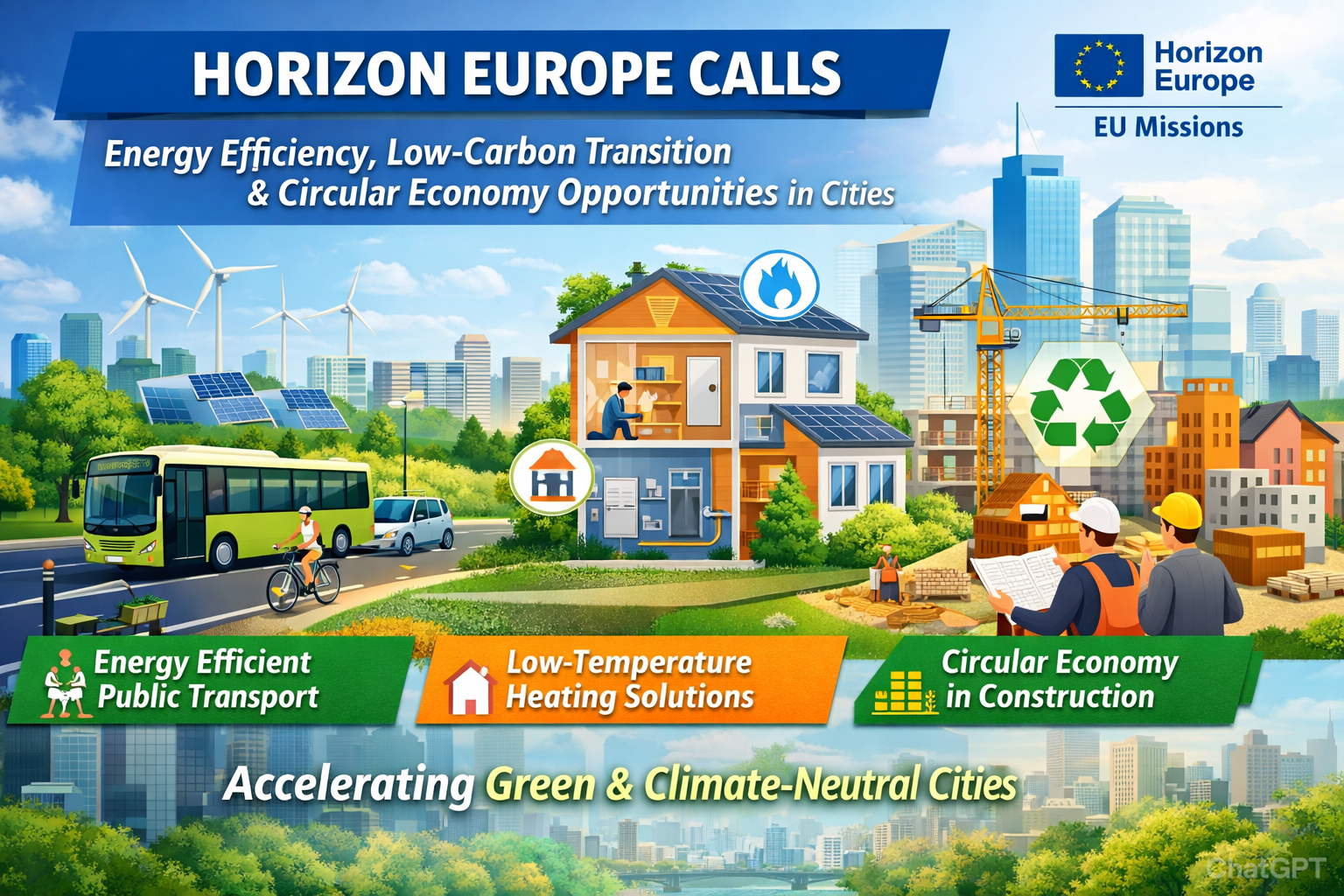
Within the framework of the EU’s Horizon Europe Programme, two important Mission calls were launched on 4 February. The deadline for submissions is 8 October 2026.
The call HORIZON-MISS-2026-04-CIT-01 “Energy efficient urban and sub-urban public transport, complemented by shared mobility” aims to increase the energy efficiency of urban and suburban public transport systems and to integrate these systems with shared mobility solutions. The call seeks to develop innovative solutions that contribute to reducing carbon emissions, optimizing transport systems, and achieving climate-neutral city objectives.
The call HORIZON-MISS-2026-04-CIT-02 “Transition to low-temperature heating solutions in multi-apartment buildings” supports the transition to low-temperature and low-carbon heating systems in multi-apartment residential buildings, with the objective of reducing building-related energy consumption and emissions. In this context, the integration of renewable energy sources, the transformation of district heating systems, and the development of energy-efficient technologies are prioritized.
The call HORIZON-MISS-2026-04-CIT-NEB-B4P-CCRI-03: “Introducing circular economy models in the construction sector, from buildings to city scale” aims to promote the adoption of circular economy models in the construction sector from building level to city scale. The call supports the development of innovative solutions in areas such as improving material efficiency, strengthening reuse and recycling practices, adopting life-cycle assessment-based design approaches, and reducing waste generation. In line with the New European Bauhaus (NEB) approach, it also promotes practices that combine sustainability, aesthetics, and inclusiveness, and seeks to foster climate-neutral, resource-efficient, and resilient urban development models. Offering strong multi-stakeholder collaboration opportunities for local authorities, construction companies, technology developers, research institutions, and financial actors, the call prioritizes holistic and scalable solutions contributing to the green transformation of cities.
All three calls represent significant funding opportunities under the EU Mission approach, which aims to enable cities to achieve climate neutrality by 2030, and provide strong international cooperation opportunities for local authorities, research organizations, industry stakeholders, and technology providers.