

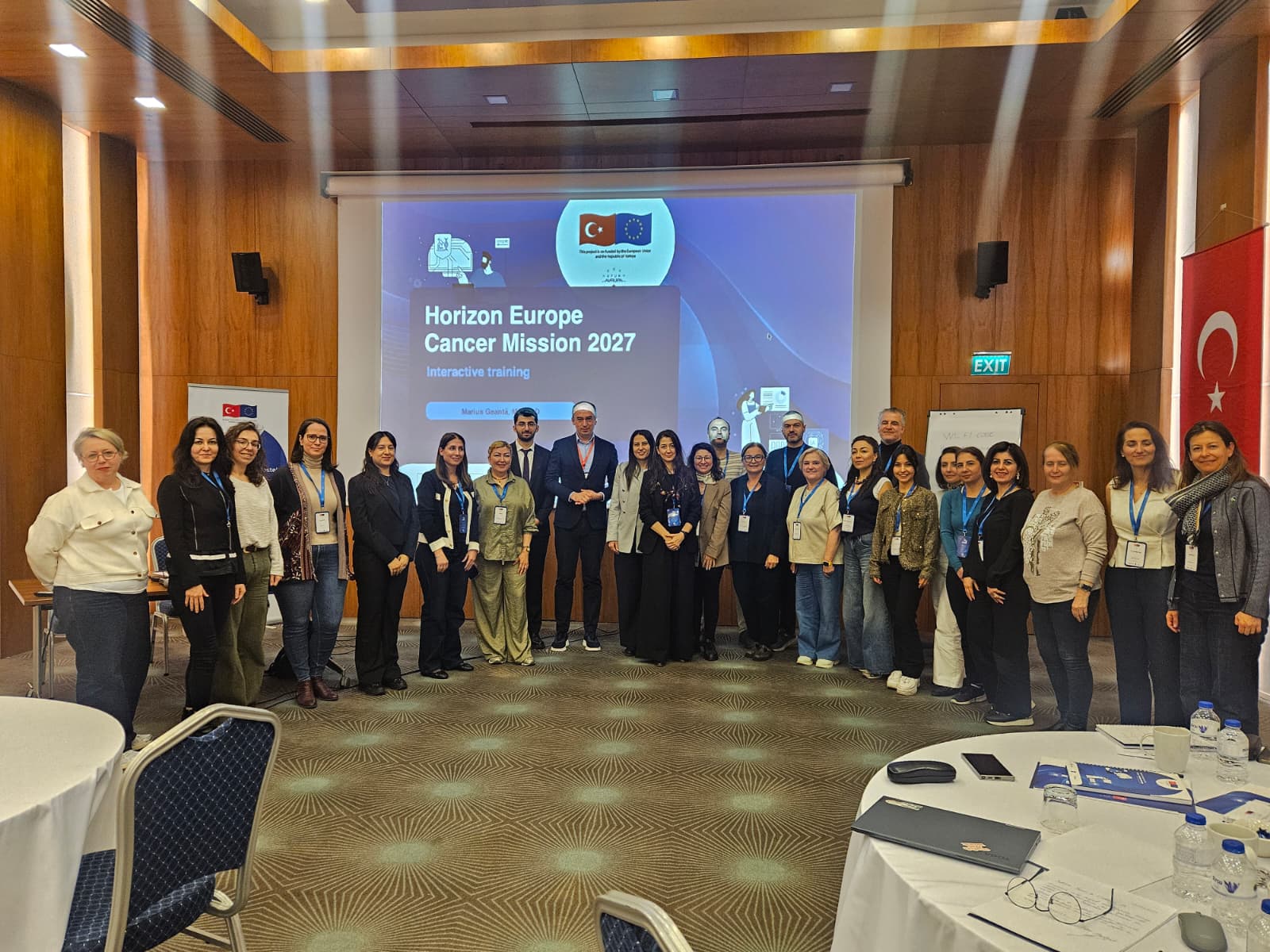
Within the scope of the Technical Assistance Project for Türkiye in Horizon Europe, the “Horizon Europe Cancer Mission Focus Group Training”, held in İstanbul on 4–5 May 2026, brought together research centres, universities, healthcare professionals, public authorities and project development stakeholders around one of Europe’s most significant transformation areas in the field of health.
Throughout the two-day programme, participants not only examined the 2027 calls under the Cancer Mission, but also had the opportunity to assess the strategic approach behind competitive project development in Horizon Europe, the expected actors within consortium structures, and the design of impact-oriented project concepts through practical sessions.
The event was held with the participation of Horizon Europe Health Cluster National Contact Points Assoc. Prof. Dr. N. Selcan Türker, Mr Gürkan Bozkurt and Ms Cansu Alanbay, representing TÜBİTAK as the main beneficiary and host institution of the project. The opening speech of the programme was delivered by Assoc. Prof. Dr. N. Selcan Türker. Throughout the interactive training programme, the National Contact Points directly addressed the questions raised by participating stakeholders and provided guiding insights on calls, application processes and project development approaches.
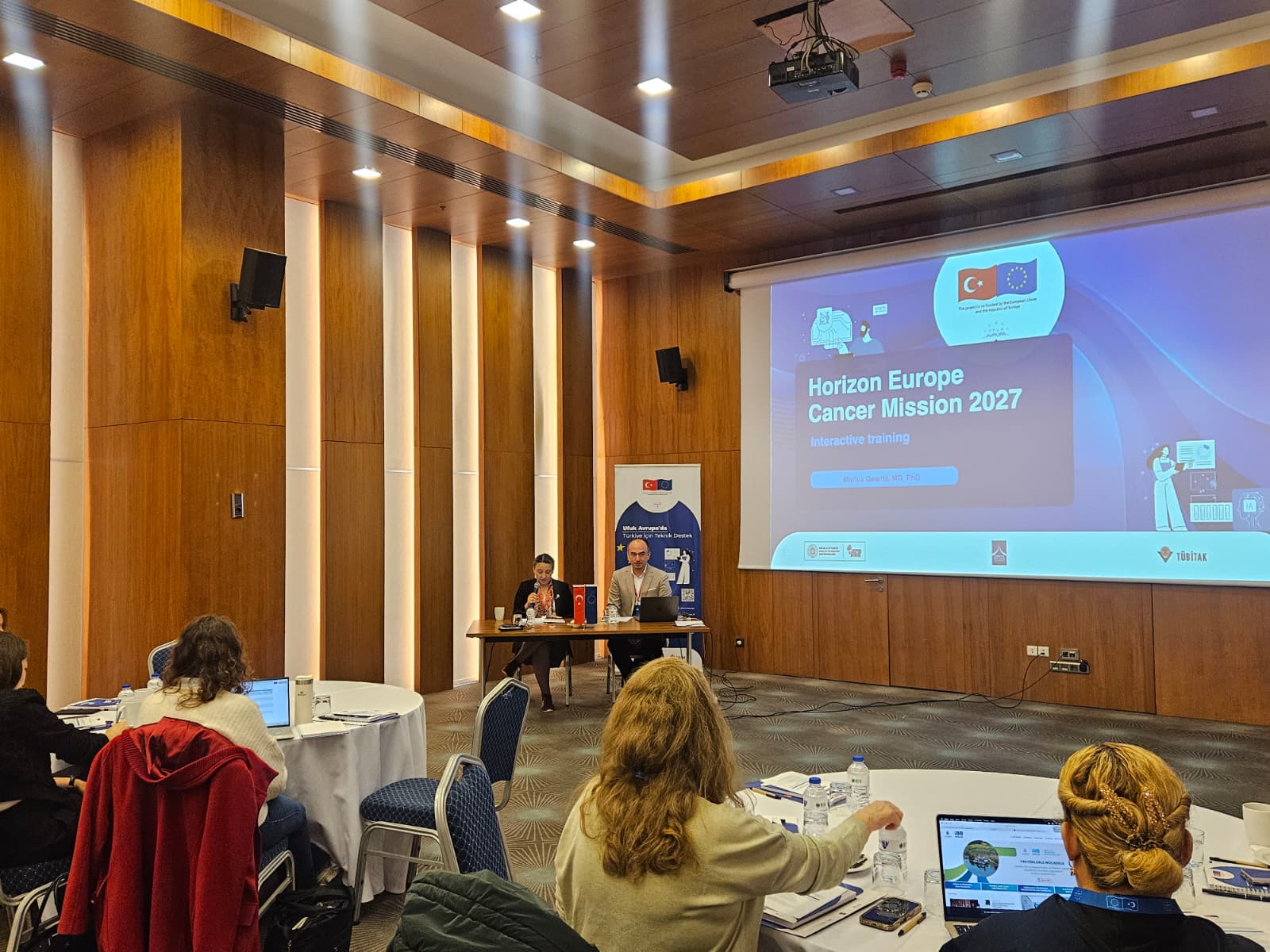
During the Focus Group Training, it was emphasised that cancer research in Europe is not only a scientific field, but also a multidimensional transformation area that brings together policy development, data management, clinical practices and societal benefit. The European Commission’s approach under the Cancer Mission, which aims to improve the lives of more than three million people by 2030, was underlined. It was also highlighted that success in Horizon Europe is not achieved solely through strong ideas, but through accurate positioning, robust partnerships and feasible project structures.
The sessions, led by Dr Marius Geantă as the trainer of the programme, went beyond a conventional training format and actively involved participants from different disciplines in project development processes. During the modules held on the first day, the structure of European Union Missions, the strategic framework of the Cancer Mission, and the key expectations of the 2027 calls were discussed in detail. Participants carried out practical exercises on matching their institutional competencies with relevant calls, assessing their potential roles, and transforming their ideas into concrete project development processes.
Within the scope of the programme, participants also took part in interactive sessions focusing on how project ideas should be shaped in terms of impact potential, European added value and feasibility.
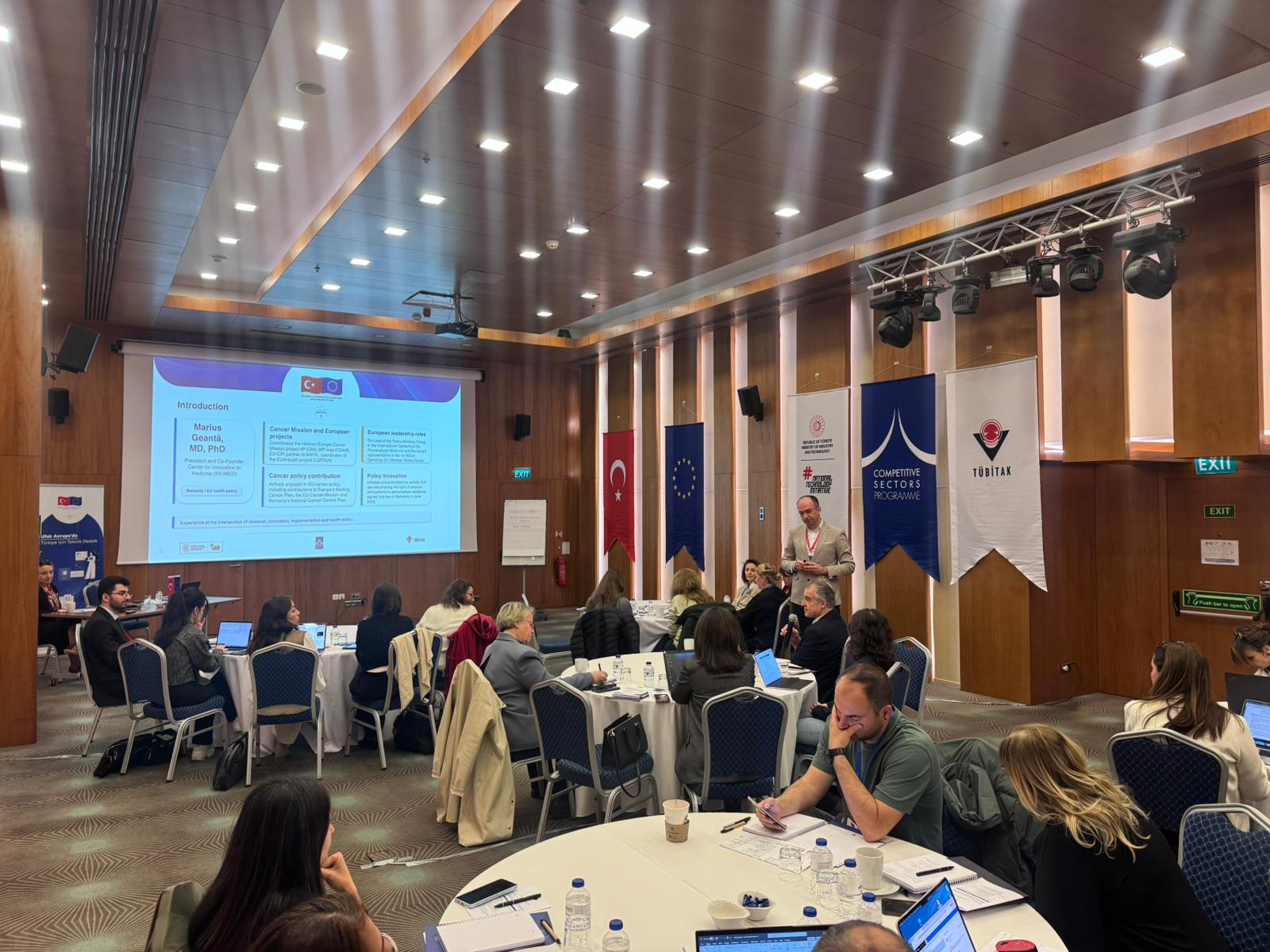
The second day of the training began with success stories from Türkiye. Prof. Dr. Emine Serap Erdine, President of the Hypertension and Atherosclerosis Association and faculty member at the Department of Cardiology, Cerrahpaşa Faculty of Medicine, and Dr Tuncay Namlı from SRDC shared their first-hand experiences from European Commission-funded projects. Their presentations offered valuable perspectives on how research ideas can be transformed into visible and competitive project structures at the European level.
In the continuation of the day, participants carried out practical work on the effective use of Horizon Europe databases in project development processes, the analysis of successful consortium examples, project design, stakeholder engagement, and common shortcomings encountered during evaluation processes.
In the final part of the programme, the “preparation for application” approach, one of the most critical aspects of project development processes, was brought to the forefront. Participants had the opportunity to revisit their project ideas in line with key evaluation criteria such as budget realism, alignment between activities and work plans, feasibility and impact logic. One of the main messages highlighted throughout the training was that impact in Horizon Europe is not an element that emerges only at the end of a project, but a strategic structure that must be systematically designed from the idea stage onwards.
Organised within the scope of the Technical Assistance Project for Türkiye in Horizon Europe, this training stood out as an important capacity-building activity aimed at strengthening the position of Türkiye’s Research Area stakeholders within the European research and innovation ecosystem.
Through two days of practical exercises, co-creation sessions and experience-sharing activities, participants were engaged not only in understanding the calls, but also in a concrete preparation process for developing competitive and feasible project ideas at the European level. We hope that the connections established, project ideas developed and cooperation grounds formed during the training will pave the way for strong Horizon Europe applications in the upcoming period.